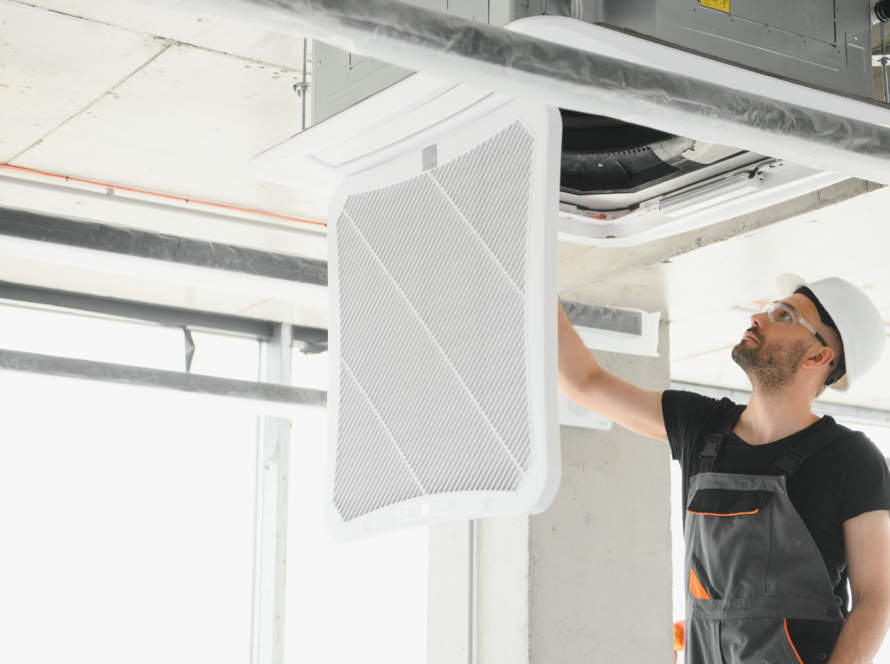
A cleanroom can have a perfectly good H14 filter on the datasheet and still fail its first validation. The filter was not the problem. The air found a way around it.
This is the part of HEPA filtration that gets the least attention. Buyers compare efficiency grades, but auditors and validation engineers ask a different question: does the installed system leak? This post explains how that test works, where leaks usually start, and what to check before a filter ever reaches your ceiling.
Filter efficiency and installed performance are two different numbers
HEPA filters are graded under EN 1822 (and the ISO 29463 series). The grade is measured on the filter itself, in a factory test rig, at the most penetrating particle size, usually between 0.1 and 0.25 microns.
| Grade | Overall efficiency (MPPS) | Local (leak) efficiency |
|---|---|---|
| H13 | 99.95% or higher | 99.75% or higher |
| H14 | 99.995% or higher | 99.975% or higher |
Look at the third column. Even at the factory, the standard allows a small local penetration at any single point, and the allowance is wider than the overall figure. Once the filter is shipped, handled, lifted into a housing and sealed into a ceiling, there are many more chances for that number to get worse.
That is why validation protocols include an installed filter leakage test. The factory certificate tells you what the filter was. The leak test tells you what you actually have.
How a HEPA leak test works
The method is described in ISO 14644-3 (test methods for cleanrooms). In a typical aerosol photometer test:
- Airflow is set to the design volume, so the filter is tested at the velocity it will work at.
- A challenge aerosol is introduced upstream. This is usually PAO (poly-alpha-olefin). Older practice used DOP (dioctyl phthalate), but most facilities have moved to PAO.
- Upstream concentration is measured through an upstream sampling port, so the instrument has a reliable reference.
- The downstream side is scanned. The photometer probe is held close to the filter face (a few centimetres) and moved in overlapping strokes at a slow, controlled speed. The frame seal, gasket line and housing joints are scanned too.
- Any reading above the acceptance limit is logged as a leak. A common limit for photometer scanning is 0.01% of upstream concentration, but the figure that applies to you is the one in your validation protocol and user requirement specification.
Notice step 3. You cannot run a proper test unless the system was built with an upstream port. This is a housing design question, and we come back to it below.
Where HEPA leaks actually start
In practice, the filter media is rarely the weak point. These are the usual suspects:
| Leak location | Typical cause |
|---|---|
| Media pinholes | Damage during transport or unpacking, fingers or tools touching the pleats |
| Filter-to-frame bond | Poor potting at manufacture, or a frame knocked out of square |
| Gasket or gel seal | Uneven compression, a dry or contaminated gel channel, a gasket that was reused |
| Housing joints | Weld or sealant gaps in the housing itself, unsealed screw holes |
| Housing-to-ceiling interface | Gaps between the housing flange and the ceiling grid or plenum |
| Duct connection | Unsealed collar, loose flexible connection |
Most of the failures in this table are installation issues. They can be prevented with handling discipline and housing designed for the job.
Why terminal housing design decides whether you can test at all
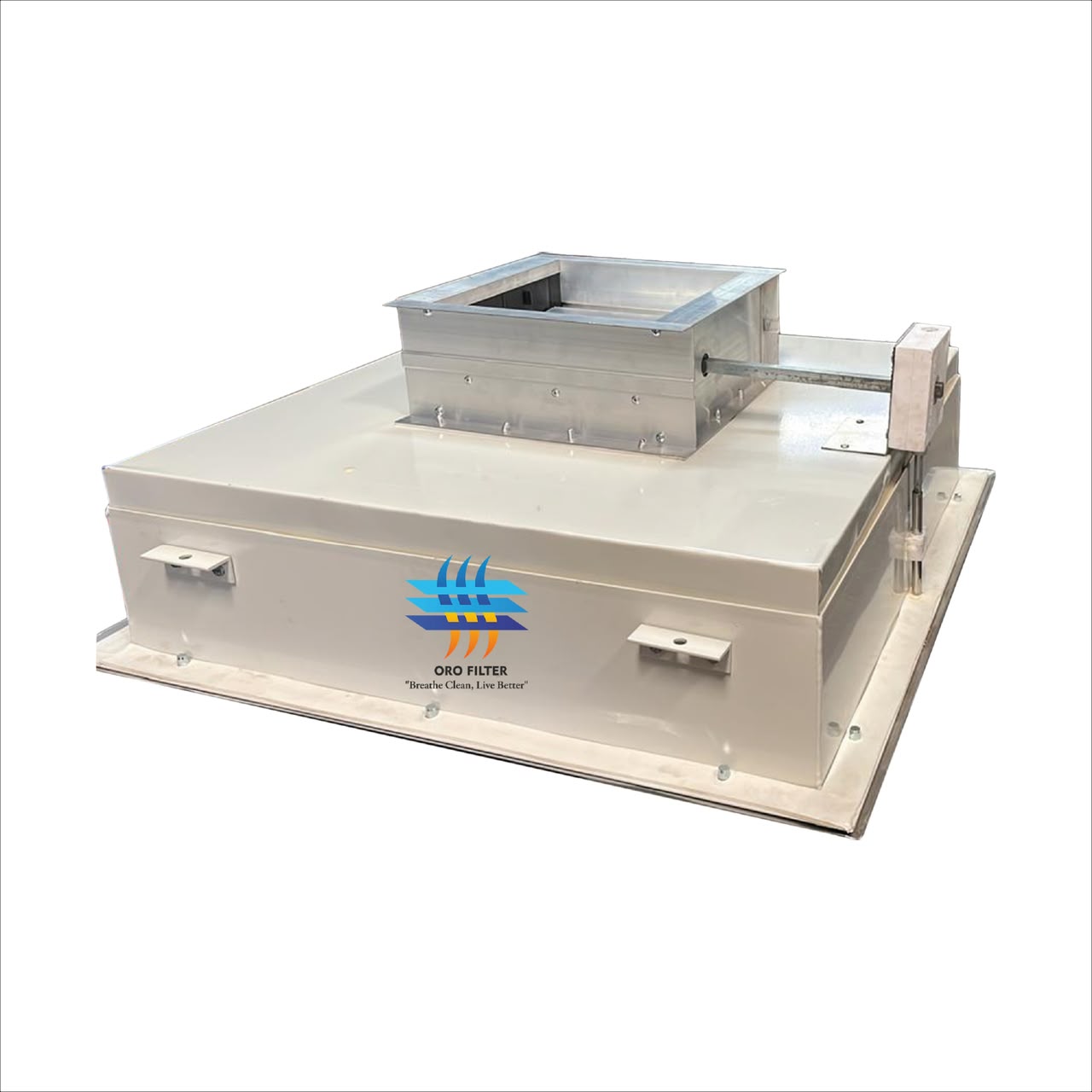
For rooms where the HEPA filter is the last barrier before the air enters the space (operation theatres, sterile filling areas, cleanroom ceilings), the terminal HEPA housing does three jobs: it holds the filter, seals it, and gives you access to test it.
Questions worth asking before you buy:
- Is there an upstream aerosol injection port and a sampling port? Without them, you cannot get a trustworthy upstream reading.
- How is the filter sealed? Gasket and gel-seal designs both work, but each needs the right installation practice. Gel seals tolerate small surface irregularities better. Gaskets need even compression.
- Can the filter be replaced from the room side? Room-side replacement keeps ceiling voids closed, which matters in a live facility.
- Is a pressure tapping available? Differential pressure readings help you decide replacement timing, as covered in our post on the filter replacement schedule.
- Is the housing material right for the room? Powder-coated steel is common. Stainless steel is often preferred where wash-down or aggressive disinfectants are used.
- Is the housing itself leak-tight? A housing made with poor welds or unsealed seams can leak even with a perfect filter inside.
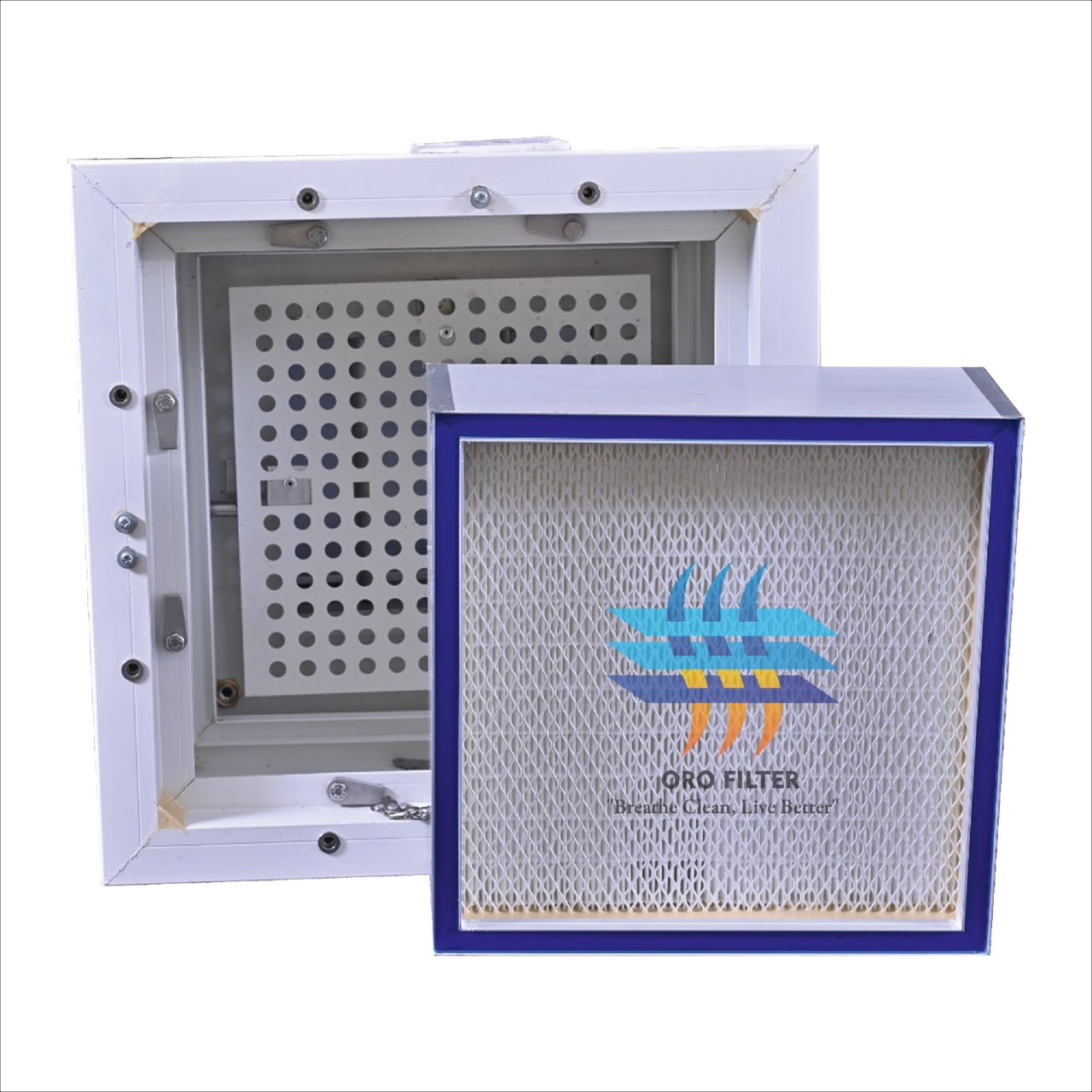
You can explore the ORO Terminal HEPA Housings alongside the ORO HEPA Filters (H13–H14) they are designed to hold.
Handling and installation: the checks that save a failed test
A few site practices make a large difference:
- Inspect on arrival. Check the carton, the frame and the media face before the filter is signed off. Visible dents or torn packaging are a reason to hold it back.
- Never touch the media. Hold filters by the frame only. Do not stack them face to face.
- Install after the room is clean. HEPA filters should go in after construction dust has been dealt with. Running a new filter through a dusty fit-out shortens its life before the room is even in use.
- Protect the upstream stages. Pre-filters and fine filters take the heavy dust load so the HEPA does not have to. This is the staged approach explained in HEPA, Fine & Pre-Filters: Understanding Industrial Filtration Stages. For high-capacity fine filtration upstream, see the ORO V-Bank Filters, and for coarse protection the ORO Pre Filters (G1–G4).
- Seat the seal evenly. Tighten clamps or frame fasteners in the sequence the housing manufacturer specifies. Over-tightening one corner can open a gap at the other.
- Do not repair casually. Patching a pinhole in critical areas is discouraged by many validation teams. When a filter fails, the safer decision is usually to replace it and retest.
What happens when the test fails
A failed scan is not a disaster. It is the test doing its job. The usual sequence:
- Mark and record the leak location and reading.
- Identify whether it is a seal, housing or media leak.
- Re-seat or re-seal if it is an installation fault. Replace the filter if the media is damaged.
- Retest the whole filter, not just the repaired spot.
- Document everything for the validation file.
Skipping the retest, or testing only at the point of repair, is what auditors tend to notice.
How often should you test?
There is no single number that suits every facility. ISO 14644-2 sets out the monitoring approach for cleanrooms, and the interval is normally decided in your validation protocol on the basis of risk assessment: room classification, product risk and your regulatory regime. Pharmaceutical units working to revised Schedule M and the guidance they follow will usually test more often than a general-purpose cleanroom.
Beyond the routine schedule, retest after:
- Any filter replacement
- Ceiling or housing work
- Major shutdowns, relocation or reconstruction
- A failed particle count or pressure cascade in the room
Where this matters most
- Operation theatres. The reasoning behind terminal HEPA in surgical suites is covered in The Surgeon You Never See and Why Air Filtration Is Critical in Operation Theatres.
- Pharmaceutical manufacturing. Filling, sterile and critical processing zones, as discussed in Why Pharmaceutical Manufacturing Cannot Compromise on Air Filtration.
- Classified cleanrooms. Understanding which class your room needs comes first, and our guide to ISO 14644 cleanroom classes explains it.
- Food and beverage lines. Where clean-air zones sit over open product, see air filtration for FSSAI and HACCP.
If a failed validation would stop production, the cost is usually much larger than the filter. The wider picture is in The Business Impact of Poor Air Filtration in Critical Manufacturing Areas.
A short checklist before you order
- Filter grade (H13 or H14) matched to the room’s requirement
- Factory test documentation available for each filter
- Housing with upstream injection and sampling ports
- Seal type agreed with the installation team
- Pressure tapping fitted
- Material and finish suited to the cleaning regime
- Handling and storage plan for the filters on site
- Leak test responsibility and schedule written into the protocol
Talk to ORO Filter
ORO Filter manufactures HEPA filters, fine filters, pre-filters and terminal HEPA housings from Pimpri-Chinchwad, Pune. If you are specifying a new cleanroom, upgrading an OT or preparing for validation, contact our team with your room class, air volume and ceiling details, and we will help you match the right filter and housing.