


Food and beverage manufacturing is one of the few industrial segments where air quality is not just an operational concern but a regulatory one. Airborne dust, mould spores, insect fragments, and cross-contamination between processing zones are all recognised hazards under India’s food safety framework. For plant operators, air filtration is not an add-on to hygiene — it is one of the control points regulators and auditors specifically look for.
This article breaks down where air filtration fits into FSSAI’s licensing requirements and HACCP-based hazard control, and what plants should actually be filtering for.
Where Air Quality Enters FSSAI’s Regulatory Framework
FSSAI’s hygiene and sanitary requirements for food businesses are laid out in Schedule 4 of the Food Safety and Standards (Licensing and Registration of Food Businesses) Regulations, 2011. This schedule applies across food manufacturing plants, storage and transportation facilities, and distribution centres, and it sets out baseline conditions for premises — including ventilation.
The regulation is explicit on one point that matters directly to filtration design: ventilation systems, whether natural or mechanical, including air filters and exhaust fans, must be designed and constructed so that air does not flow from contaminated areas into clean areas. This single clause is effectively the regulatory basis for air segregation between zones such as raw material intake, processing, and packaging in any FSSAI-licensed facility.
Beyond this, Schedule 4 requires that premises be adequately ventilated and lighted, that storage areas remain dry and well ventilated, and that sanitary conveniences have sufficient natural or mechanical ventilation. None of these clauses specify filter grades or airflow rates — FSSAI’s approach is performance-based rather than prescriptive — but they establish that ventilation and filtration are inspectable compliance items, not discretionary upgrades.
How HACCP Treats Airborne Contamination
Where FSSAI sets baseline premises requirements, HACCP (Hazard Analysis and Critical Control Point) is the system most food businesses use to manage risk within those premises. HACCP is a preventive framework: it identifies biological, chemical, and physical hazards at each stage of production and builds controls around them rather than relying on end-product inspection.
Airborne contamination sits across all three hazard categories. Biologically, unfiltered air can carry mould spores and bacteria into product zones. Physically, dust and particulate matter can settle into open product streams, especially in dry processing operations like flour milling, spice grinding, or powder blending. Chemically, air drawn from outside can carry industrial pollutants in plants located near other manufacturing activity.
Where a HACCP team identifies airborne contamination as a significant hazard at a given process step — commonly at open product exposure points, filling lines, or post-lethality zones in ready-to-eat production — air filtration becomes a control measure at that Critical Control Point, with monitoring and verification built around it. This is the practical link between what looks like a facilities decision (which filters to install) and a documented food safety requirement (a controlled hazard with a monitoring record).
Contamination Risks Specific to Food & Beverage Environments
A few risk patterns come up repeatedly across food processing categories:
- Dry processing and powder handling (flour, spices, dairy powders, protein blends): airborne particulate can cross-contaminate allergens or introduce foreign matter into open product streams.
- Bakery and confectionery: flour dust is both a contamination and a combustion risk, and ambient mould spores affect shelf life.
- Dairy processing: high humidity combined with organic particulate creates favourable conditions for microbial growth if make-up air isn’t adequately filtered.
- Ready-to-eat and post-lethality zones: any area after a kill step (cooking, pasteurisation) needs air control to avoid reintroducing the pathogens the process just eliminated.
- Beverage bottling and filling: airborne particulate near open filling heads is a direct contamination path into the final sealed product.
Each of these calls for a different filtration response — a blanket approach to filtration across a plant is neither compliant in the audit sense nor efficient in the cost sense.
Matching Filter Stages to Processing Zones
A layered filtration approach is the standard used across compliant food plants:
Pre-filters (coarse/panel filters) capture larger particulate — dust, insects, lint — at the air handling unit intake. These protect downstream, finer filters from premature loading and are the baseline layer in every zone.
Fine filters (bag or pocket filters), typically in the MERV 13–16 or equivalent ISO 16890 ePM1 range, handle finer particulate and are appropriate for general processing and packaging areas where product is open to ambient air for parts of the process.
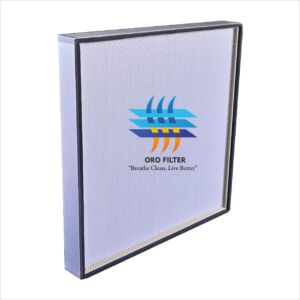
HEPA filtration is reserved for higher-risk zones: aseptic filling lines, infant nutrition production, injectable-grade pharmaceutical-adjacent processes, or any area classified under cleanroom standards. HEPA filters are certified to remove particles at 0.3 microns with at least 99.97% efficiency — a specification worth confirming against test certificates rather than taking on a supplier’s word, since “HEPA-grade” and “true HEPA” are not interchangeable claims in the market.
Positive pressure cascade — where cleaner zones are held at higher air pressure than adjoining areas — is the mechanical answer to FSSAI’s requirement that air not flow from contaminated to clean areas. This is achieved through filtration stage design combined with airflow balancing, not filtration alone.
What This Means for Plant Operators
A few practical takeaways for teams responsible for compliance and facility operations:
- Map filtration to your HACCP hazard analysis, not to a generic industrial standard. The filter grade needed at a spice grinding line is different from what’s needed at a UHT milk filling line.
- Document filter specifications and replacement schedules as part of your food safety management system records — this is what auditors ask for, not just visible filter installation.
- Treat pressure differentials between zones as a measurable parameter, not an assumption. Positive pressure cascades need periodic verification, particularly after any HVAC modification.
- Budget for replacement cycles, not just installation. A fine or HEPA filter loaded past its service life stops functioning as a control point even if it’s physically still in place — which becomes a compliance gap during audits.
Air filtration in food and beverage manufacturing sits at the intersection of two systems that are often managed by different teams — facilities and quality/food safety. Getting the filtration design right means treating it as a documented control point within HACCP, built on the ventilation baseline FSSAI already requires, rather than as a standalone HVAC decision.

1 Comment