A project brief often reads: “We need an ISO 7 cleanroom, so please quote HEPA filters.” That sentence mixes up two different things. ISO 7 describes how clean the air in the room must be. HEPA describes a type of filter that helps the room reach that cleanliness. The standard sets the target; the filtration, airflow and room design are how you meet it.
This guide explains what ISO 14644 classes actually measure, how filter grades such as G4, F7, H13 and H14 fit into a cleanroom, and how to choose a sensible filtration train for your facility. It is written for plant heads, QA teams, project engineers and procurement managers who deal with an air filter manufacturer in Pune or elsewhere in India and want to specify the right product the first time.
What ISO 14644-1 Actually Measures
ISO 14644-1 is the international standard that classifies air cleanliness by particle concentration. The current edition is ISO 14644-1:2015. It does not tell you which filter to buy. It defines the maximum number of airborne particles allowed in one cubic metre of air, for specific particle sizes, for each class from ISO 1 (cleanest) to ISO 9.
Two points are often missed:
- Classification is tied to an occupancy state. A room can be classified “as-built” (empty, no equipment), “at-rest” (equipment installed, no people) or “operational” (normal working conditions). A room that meets ISO 7 at-rest may not meet it in operation. Always state which state your class refers to.
- Class is a result, not a component. A room reaches its class through a combination of filtration, air change rate, airflow pattern, pressure control, room finishes, gowning and cleaning discipline.
ISO 14644-1 Cleanroom Classes at a Glance
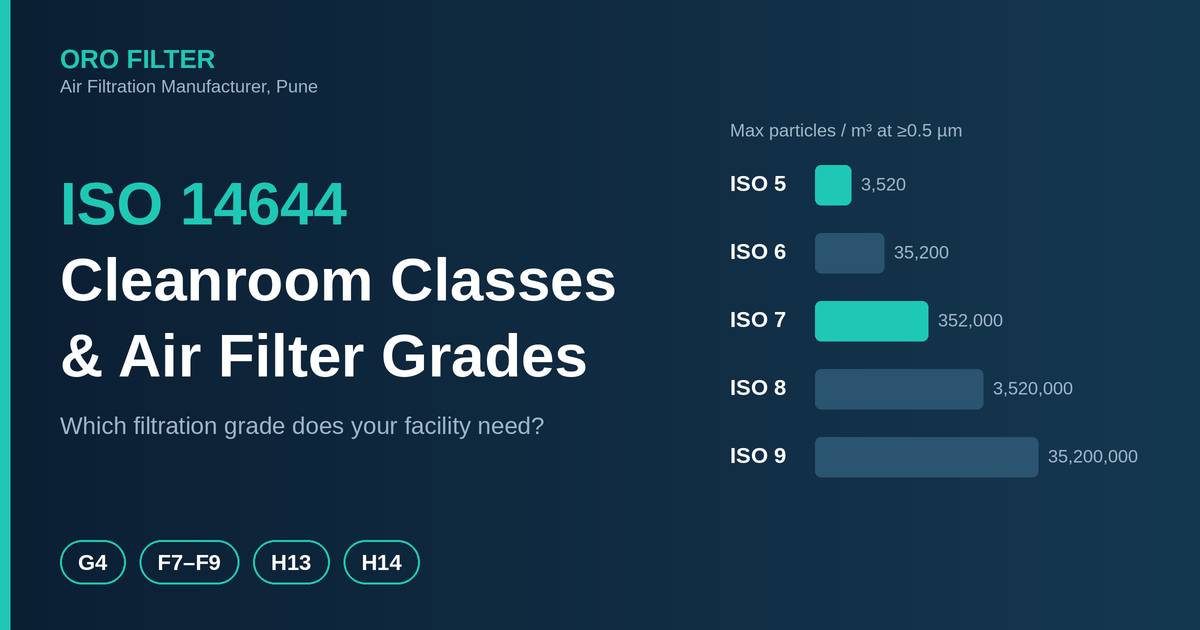
The table below lists the maximum permitted particles per cubic metre for the 0.5 µm and 5 µm sizes for classes ISO 5 to ISO 9, which cover most industrial, pharmaceutical and hospital applications in India. Lower classes (ISO 1 to 4) are defined using smaller particle sizes and are mostly used in semiconductor and nanotechnology work.
| ISO Class | Max particles/m³ at ≥0.5 µm | Max particles/m³ at ≥5 µm | Older FS 209E equivalent |
|---|---|---|---|
| ISO 5 | 3,520 | 29 | Class 100 |
| ISO 6 | 35,200 | 293 | Class 1,000 |
| ISO 7 | 352,000 | 2,930 | Class 10,000 |
| ISO 8 | 3,520,000 | 29,300 | Class 100,000 |
| ISO 9 | 35,200,000 | 293,000 | Room air (approximate) |
Federal Standard 209E was withdrawn in 2001, but many Indian drawings, vendor quotations and older facilities still refer to “Class 100” or “Class 10,000”. It helps to know both labels. Always confirm figures against the current text of ISO 14644-1 before using them in a URS or validation document.
For scale, ordinary indoor air in a city typically contains millions of particles of 0.5 µm and above per cubic metre, which is why a controlled environment needs deliberate filtration and not just a closed door.
Why the Filter Grade Is Not the Same as the Cleanroom Class
Buyers sometimes ask, “Which filter gives us ISO 7?” No single filter does. Consider what else decides the outcome:
- Air change rate (ACH): Clean, filtered supply air dilutes and removes particles generated inside the room. A higher class usually needs more air changes.
- Airflow pattern: Cleaner zones use unidirectional (laminar) flow from the ceiling, while ISO 7 and ISO 8 rooms usually use turbulent (non-unidirectional) flow.
- Pressure cascade: Cleaner rooms are held at higher pressure than adjacent rooms so air flows outward, not inward. A positive differential of at least 10 Pa between adjacent rooms of different grade is a widely used design value in pharmaceutical guidance.
- Particle sources: People, materials, machines and processes generate particles. A room with heavy activity needs more filtered air than an idle one.
- Leak-free installation: A HEPA filter with a damaged media or a poor seal can allow unfiltered air through, so the room fails despite the right grade on paper.
Treat the filter as one important link in a chain. A good HVAC designer will size the whole system; your job as the buyer is to supply filters that match the design, with test documentation to prove it.
Air Filter Grades You Need to Know
Three filter classification systems appear in Indian specifications, and it is common to see them mixed on one drawing.
- EN 779 grades (G, M, F): G4 (coarse), M5 and M6 (medium) and F7 to F9 (fine). EN 779:2012 has been withdrawn and replaced by ISO 16890, but the G and F labels are still widely used in tenders and on older HVAC drawings.
- ISO 16890 groups: ISO Coarse, ISO ePM10, ISO ePM2.5 and ISO ePM1. These report efficiency against particulate matter size ranges and are closer to real-world air quality concerns.
- EN 1822 grades (E, H, U): E10 to E12 (EPA), H13 and H14 (HEPA), and U15 to U17 (ULPA). These are tested at the most penetrating particle size (MPPS). The international counterpart is ISO 29463.
| Filter grade | Typical role | Efficiency reference |
|---|---|---|
| G4 | Pre-filter, protects downstream filters | Coarse dust arrestance |
| F7 to F9 | Fine filter in AHU, protects HEPA | Rated by ISO 16890 ePM1 / ePM2.5 or EN 779 average efficiency |
| H13 | Terminal HEPA filter | At least 99.95% at MPPS (integral value) |
| H14 | Terminal HEPA filter for stricter zones | At least 99.995% at MPPS (integral value) |
| U15 and above | ULPA, for very low classes | At least 99.9995% at MPPS |
For a deeper explanation of how each stage works, read our guide on HEPA, Fine and Pre-Filters: Understanding Industrial Filtration Stages.
The Multi-Stage Filtration Train
Cleanrooms use filters in stages, because a HEPA filter loaded with coarse dust will clog quickly and cost far more to replace. A typical train looks like this:
- Stage 1: Pre-filter (G4 or M5) at the fresh-air intake or AHU inlet. It removes large particles, insects and fibres.
- Stage 2: Fine filter (F7 to F9 / ePM1) inside or after the AHU. It captures finer dust and extends the life of the terminal filter.
- Stage 3: Terminal HEPA (H13 or H14) in the ceiling or supply grille inside the cleanroom. This is the last barrier before air enters the room.
- Optional: Return or exhaust filtration where the process generates hazardous, potent or biological material.
Placing the HEPA filter at the point of supply, not only in the AHU, is a common design choice, because it also catches particles shed by the ductwork.

Indicative Filter Selection by ISO Class
The table below gives a typical starting point used during early design discussions. It is not a substitute for the HVAC designer’s calculation, and actual choices vary with process, risk assessment and applicable regulation.
| ISO Class | Typical airflow | Typical filtration approach | Common applications |
|---|---|---|---|
| ISO 8 | Non-unidirectional | G4 + F7/F8 in AHU, HEPA (H13) often used at terminal | Oral solid dosage areas, packaging, general electronics assembly |
| ISO 7 | Non-unidirectional, higher ACH | G4 + F8/F9 in AHU, terminal HEPA H13 or H14 | Pharmaceutical background rooms, medical device assembly, hospital operation theatres (design dependent) |
| ISO 6 | Mixed | Terminal HEPA H14 with high ceiling coverage | Specialised electronics, sensitive component assembly |
| ISO 5 | Unidirectional | Terminal HEPA H14 (or ULPA) with high ceiling coverage | Aseptic filling zones, laminar flow workstations, critical sterile work |
As a design-practice guide, airflow velocity in ISO 5 unidirectional zones is commonly designed around 0.45 m/s, and air change rates rise sharply as the class gets cleaner. ISO 14644 does not mandate a fixed ACH, so these values come from design guidance and project risk assessment.
Industry View: Which Sector Needs What
Pharmaceutical manufacturing
Pharmaceutical plants usually refer to the EU GMP Annex 1 grades alongside ISO classes. Grade A corresponds to ISO 5. Grade B is ISO 5 at rest and ISO 7 in operation. Grade C is ISO 7 at rest and ISO 8 in operation. Grade D is ISO 8 at rest. In India, the revised Schedule M under the Drugs Rules, 1945 (notified in December 2023, with phased compliance timelines) raised expectations around premises, HVAC and environmental control, so many manufacturers are upgrading their air systems. Confirm the current compliance dates applicable to your unit before planning. Read more in Why Pharmaceutical Manufacturing Cannot Compromise on Air Filtration.
Hospitals and operation theatres
Operation theatres rely on filtered supply air to reduce airborne contamination at the surgical site. Many designs use terminal HEPA filters and controlled pressure relative to corridors. The right class and layout depend on the type of surgery and the hospital’s design standard. Our article Why Air Filtration Is Critical in Operation Theatres covers the clinical side in detail.
Medical devices and electronics
Device assembly, sterile packaging and electronics work commonly sit in ISO 7 or ISO 8 rooms. Semiconductor and nanotechnology fabrication work in much lower classes, where ULPA filtration and strict particle monitoring apply.
Food and beverage
Food plants are generally not classified under ISO 14644, but high-care and ready-to-eat areas still benefit from controlled filtered air. See our piece on air filtration for food and beverage plants from an FSSAI and HACCP perspective.
Testing and Recertification: Proving the Class
A cleanroom is not “certified once and forgotten”. ISO 14644-2 sets out monitoring and re-testing expectations, and ISO 14644-3 describes test methods. In practice:
- Airborne particle count: Re-testing intervals under ISO 14644-2 are a maximum of 6 months for classes ISO 5 and cleaner, and 12 months for classes above ISO 5.
- Airflow volume or velocity and differential pressure: Typically checked at least every 12 months.
- HEPA filter integrity (leak) test: An aerosol photometer test, using a challenge aerosol such as PAO, scans the filter face and seal for leaks. A common acceptance limit is a leak above 0.01% of the upstream concentration.
- Installed filter checks: Gasket condition, frame seal, housing leakage and pressure drop across each stage.
Ask your filter supplier for a batch test report for each HEPA filter, and plan in-situ integrity testing after installation and after any filter change.
Common Mistakes When Selecting Cleanroom Filters
- Specifying H14 everywhere. A higher grade costs more, and the room may not need it. Match the grade to the class, risk assessment and process.
- Skipping the pre-filter stage. Without G4 and F7 to F9 stages, terminal HEPA filters load early and need premature replacement.
- Ignoring pressure drop. A filter with high resistance raises fan energy use over its life. Compare initial and final pressure drop, not just price. Our filter replacement schedule guide explains how to track this.
- Mismatched dimensions. Filters that do not fit the housing exactly allow bypass leakage, which no grade can correct.
- Treating filtration as the only fix. If a room fails particle counts, the cause may be airflow, pressure cascade, door discipline or cleaning practice rather than the filter.
- No documentation. Without test reports, material details and traceability, validation becomes harder at audit time.
How to Choose an Air Filter Manufacturer in Pune for Cleanroom Projects
If your facility is in or near Pune, Pimpri-Chinchwad, Chakan, Talegaon or Ranjangaon, working with a local air filter manufacturer in Pune has practical advantages: shorter delivery for replacement stock, easier site visits, and quicker coordination when sizes or specifications change. Whichever supplier you consider, check these points:
- Range across stages: Can they supply pre-filters, fine filters and HEPA filters, so the whole train is matched?
- Custom sizes: Can they make filters to fit existing housings and AHUs?
- Test and quality documents: Do they provide filter test reports and material specifications you can attach to validation files?
- Technical support: Will they review your class, ACH and layout and give grade recommendations, rather than only quote a price?
- Replacement planning: Can they help you set pressure-drop limits and replacement intervals?
- Lead time and stock: Is there a plan for urgent replacements so production does not stop?
Frequently Asked Questions
What is the difference between an ISO 7 and an ISO 8 cleanroom?
ISO 7 allows up to 352,000 particles of 0.5 µm and larger per cubic metre, while ISO 8 allows up to 3,520,000. ISO 7 is ten times cleaner and usually needs more air changes and tighter control.
Do I need a HEPA filter for an ISO 8 room?
Not always. Some ISO 8 rooms are served by well-designed fine filtration (F7 to F9) alone, while many pharmaceutical and sensitive-process designs add terminal HEPA filters. The decision depends on the process, risk and applicable regulation.
What is the difference between H13 and H14 filters?
Both are HEPA grades under EN 1822. H13 has an integral efficiency of at least 99.95% at the most penetrating particle size, and H14 at least 99.995%. H14 is used where tighter control is needed.
How often should HEPA filters be replaced?
There is no fixed calendar for every site. Replacement depends on pressure drop, the particle load, integrity test results and the facility’s validation plan. Many plants replace based on measured pressure drop or a failed integrity test.
Is a cleanroom classification valid forever?
No. ISO 14644-2 requires periodic re-testing, and the room must be re-tested after major changes such as filter replacement, HVAC modification or layout changes.
Can a pre-filter alone make a room an ISO class?
No. Pre-filters protect the downstream filters and equipment. Cleanroom classes require a complete system including fine and HEPA filtration, airflow design and pressure control.
Conclusion
ISO 14644 gives a clear way to describe how clean the air must be. Choosing the filtration to meet it means looking at the class, the process, the airflow design and the validation plan together. A sensible starting point is a three-stage train (G4, F7 to F9, then H13 or H14 at the terminal), adjusted by the HVAC designer and confirmed through integrity testing.
Oro Filter is an industrial air filtration manufacturer based in Talwade, Pimpri-Chinchwad. If you are planning a new cleanroom, upgrading an existing one, or comparing grades for a project, share your room class, size and current filter details with us, and our team can help you match filter grades to your requirement. Contact us to start the conversation.
Note: Values in this article are drawn from ISO 14644-1:2015, EN 1822 and general design practice. Always confirm requirements against the current published standards, your applicable regulation and your HVAC designer’s specification.